Well well well, HAPPY NEW YEAR (can we still say that in Feb? unsure).
This time of year always feels so odd. Half the world is still mentally on holidays, the other half is deep in new year, new strategy mode, and I’m somewhere in the middle trying to work out if it’s too early to have strong thoughts about anything. But alas, we’re here with a couple of rants, a couple of applause-worthy stunts andddd covered in aloe vera cream because I forgot my SPF on the weekend.
Let’s dive in!
a marketing thoughts playground: THE AUSSIE OPEN 🎾
I have way too many thoughts about the Australian Open this year, so we’re doing this in parts.
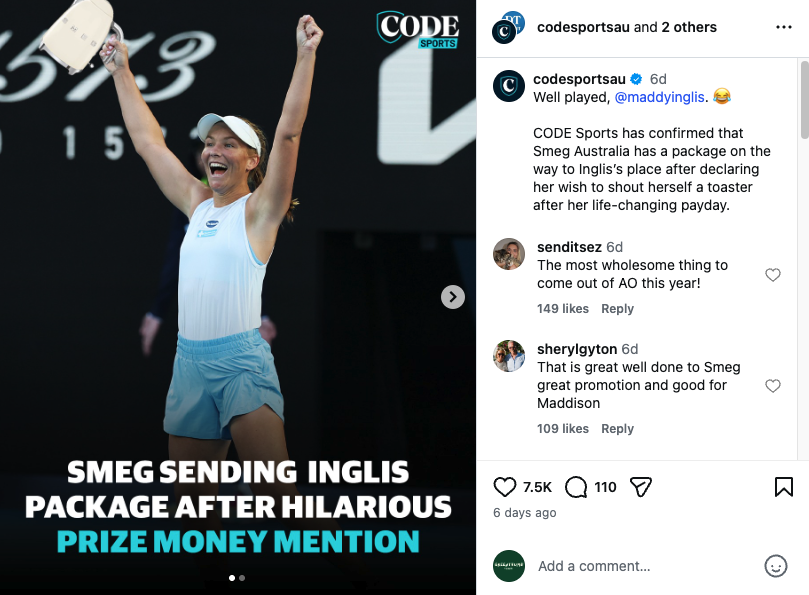
Part 1: Madison Inglis.
If you missed it, she made it through to round four for the first time ever, and in her post-match interview she was asked what she’d spend her prize money on. Her answer? A Smeg toaster and kettle. Which is honestly one of the most relatable things I’ve ever heard from a professional athlete. It’s cute, but it’s also a little bit brutal. Because it really highlights how hard it must be to compete at that level and still be scraping by. You’re on TV. You’re representing Australia. You’re playing at the Australian Open… and your big dream purchase is a toaster.
What I LOVED is that Smeg actually listened and sent her a whole care package. Because if they hadn’t, this would’ve been a very different marketing thought about the biggest missed opportunity of the month. Instead, they got a completely organic brand moment with someone who is basically the perfect poster child for them. She’s humble. She’s grateful. She’s genuinely excited about a household appliance. You literally could not cast that better if you tried.
And what makes it even better is how low effort it was from Smeg’s side. If they’d tried to do this as a proper campaign – reach out to her agent, negotiate a contract, plan a shoot, approve copy – you’re easily talking tens of thousands of dollars (and realistically, would anyone even believe she loved Smeg that much?). Instead, they sent her a toaster and a kettle. The product cost is tiny. The PR value is massive. She posts about it. News outlets pick it up. People talk about it. Suddenly Smeg looks like a brand that “gets it”.
I know this is a unicorn moment and not something you can plan for, but I think the bigger lesson is about recognising genuine brand love when it appears. When someone is already talking about you, already excited about you, already aligned with what you sell – that is such a gift. And so many brands just… ignore it.
On a much smaller scale, this could be someone constantly recommending your Pilates studio to their friends. Or a regular at your café who brings in new customers every week. Or someone who talks about your skincare brand on their story without you ever asking. Instead of just thinking “oh that’s nice”, why wouldn’t you lean into that? Give them free access. Give them a thank you. Turn them into a natural ambassador instead of spending money trying to manufacture one. People trust people WAAYYYYY more than they trust ads.
Part 2: influencers at sporting events.
I saw so many people this year complaining about influencers being at the Australian Open. “They’re not real fans.” “They don’t even know who’s playing.” “Why are they there instead of actual tennis lovers?” And I honestly… don’t get the outrage at alllllll.
Influencers aren’t there because Tennis Australia thinks they’ll appreciate a perfect cross-court shot. They’re there because they bring new eyeballs. They bring different audiences. They bring people who might never normally care about tennis but suddenly see it because someone they follow is there, dressed up, drinking Aperol, posting stories.
It’s exactly what happened in the US with Taylor Swift and the NFL. An entire new demographic started caring about football because they cared about her. And suddenly the NFL had younger fans, more women watching, more cultural relevance. But for some reason, when it’s influencers, people act like it’s some kind of crime.
I am unsure why (jealousy? who knows) but influencers are always the villain. There’s this assumption that they don’t “deserve” to be there/anywhere for that matter. But from a marketing perspective, if your goal is to grow the event, grow the sport, and grow the audience… they absolutely have a role to play.
They’re not there instead of fans. They’re there for future fans. More eye balls > More money for the sport > bigger arenas > more events generally… the list goes on.
Part 3: brand integrations.
The Aussie Open is SO brand-heavy. Logos everywhere. Activations everywhere. Freebies everywhere. It’s borderline overwhelming (note: it absolutely is overwhelming). Which always raises the question to me: is it even worth joining that noise? When there are hundreds of brands competing for attention, how do you stand out without just becoming visual clutter?
And for me, the answer is always context.
I’ve been in past years, and one time I went Country Road had an escape room activation. And I remember standing there thinking… why? It didn’t feel like Country Road. It didn’t feel tennis-related. It didn’t feel like it belonged in 35-degree heat with people holding overpriced wine. It felt like an idea that existed in isolation, without thinking about where it was actually going to live. And yes, I did the escape room and waited in line and the water bottle consolation prize I got was absolutely not worth it.
Compare that to Mecca this year, who had SPF sunscreen stations. That makes sense. It’s summer. People are outdoors all day. They’ve forgotten sunscreen. They’re burning. They’re sweaty. They actually need help. That’s context done properly. You’re not forcing people into something – you’re helping them in the moment they’re already in.
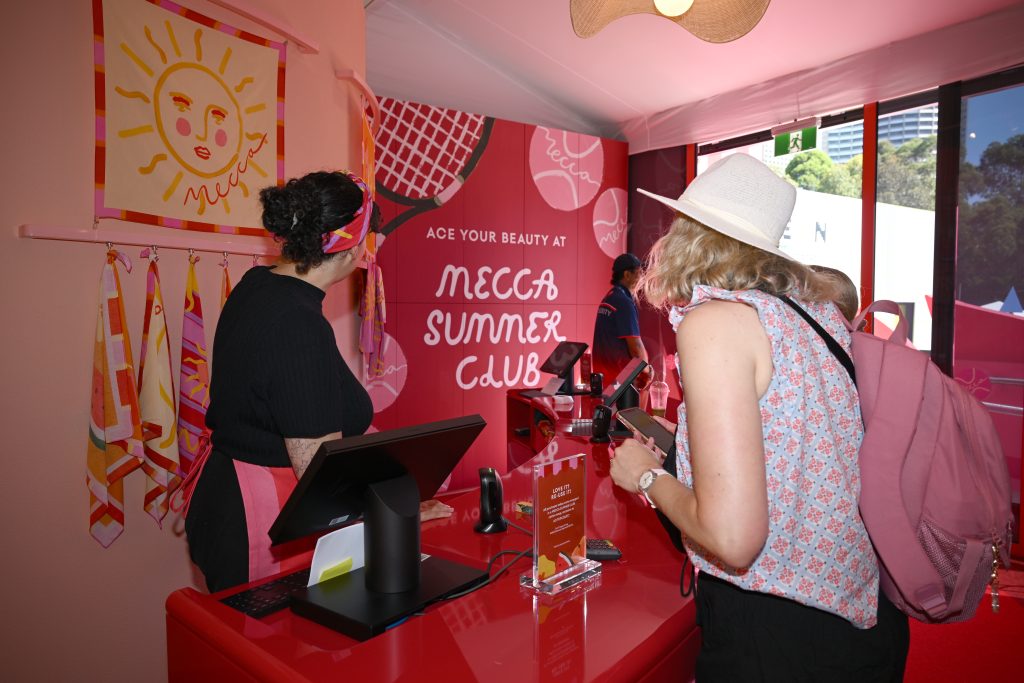
The big key thing for me is that context beats creativity every time. A bloody epic idea in the wrong environment is still a bad idea. Think about the moment people are having. Are they hot? Are they bored? Are they waiting in line? Do they want something quick or immersive? Does your idea require a 30-minute queue, and if so… do they actually want to do that?
Brand activations aren’t really about showing off or having the fanciest looking stand. They’re about fitting into someone’s day without annoying them (and for the love of god – please think about the logistics of 1000’s of people wanting to experience it).
should you pay for people to say you’re smart?
I saw a loooooot of coverage this month about Airwallex looking for influencers to create paid content praising their founder, Jack Zhang, and his thought leadership. And people absolutely lost their minds about it. “You can’t pay people to say you’re smart.” “This is fake.” “This is embarrassing.” And yet… we have no issue paying influencers to say a brand is good. We pay PR agencies to spin stories. We pay for advertorials. We literally pay for reputation all the time.
So why does it feel different when it’s a person instead of a product?
I went back and forth on this a lot (maybe more than I should? Someone send me a new hobby please). And I think the line for me is whether the endorsement is genuine. If you’re finding people who already respect his thinking, already follow him, already talk about his ideas… and you’re paying them to amplify that? That feels pretty similar to normal influencer marketing. But if you’re paying people who don’t even know who he is to suddenly declare him a genius? That’s where it feels kinda gross.
All this thinking did make me think more broadly about sponsored content though. On my reno Instagram account, we work with brands who give us tools and products, but we genuinely use them. If someone asked me, “Do you actually like those boots?” the answer would be yes. Same with Ryobi. That’s why it works. If I had to pretend? It would be obvious in about two seconds and I’d probably say no because I’m a terrrrrrible liar.
So maybe the real question isn’t “can you pay for praise?” but “is the praise true?” Genuine endorsements always land better than manufactured ones. And audiences are way more perceptive than we give them credit for. I guess it’s basically the same thing as Maddison in the Aussie Open and her genuine love for Smeg – amplifying a pre-existing love? Totally fine. Paying Maddison to say at the end of her match “I LOVE SMEG” when she’s never had it before… not so much?
just because you’re posting doesn’t mean you should be
I had one of my first calls of the year with someone who wanted to outsource their personal LinkedIn. And when I explained that personal LinkedIn works best when it’s actually… personal, he basically said he didn’t care what went on there. He just wanted to “be on LinkedIn”. It didn’t need to sound like him. It didn’t need to reflect him. It just needed to exist.
This stressed me out more than I care to admit.
Because in my head, I’m like… what is the point of that? You’re not building trust. You’re not building a reputation. You’re not even really building a presence. You’re just ticking a box so you can say you’re “active on LinkedIn,” even if what’s there has absolutely nothing to do with you as a person. And then when someone actually meets you in real life and goes, “Oh, I follow you on LinkedIn,” they’re basically meeting a completely different character. Which feels… odd? And also kind of pointless?
It made me realise how much marketing has quietly become a box-ticking exercise. “We should be on LinkedIn.” “We should post twice a week.” “We should be on TikTok.”
All without ever stopping to ask: why? What’s the goal here? Who is this actually for? And what do we want them to feel or do because of it?
There’s this weird assumption that showing up somewhere automatically equals good marketing. But just being present doesn’t mean you’re being effective. And just because everyone else is doing something doesn’t mean it makes sense for you to do it too. Especially when the effort going in doesn’t match the outcome you want coming out.
In an age where content is absolutely everywhere, doing something badly or lazily is honestly worse than not doing it at all. You’re still spending time. You’re still spending money. You’re still using energy. But you’re getting no return – and sometimes you’re even doing damage, because people are forming an impression of you based on something that isn’t really you.
And now with AI making it easier than ever to pump out endless content, this matters even more. The internet doesn’t need more posts. It needs better ones. Or at least ones that are intentional. If you’re going to show up somewhere, it should be for a reason. Not just because you feel like you should.
This one’s probably more a rant than anything – but if there’s one thing I WON’T be doing in 2026, it’s box ticking.
my beloved mecca finally disappoints me
This one annoyed me more than it probably should have and I swear I’m not a brat. Last year, Mecca ran this whole thing for Beauty Loop members saying that if you collected every single Beauty Loop box across 2025, you’d get a special beauty reward in January 2026. Which, obviously, worked perfectly on me. I made sure I got every box. I was committed. I was loyal. I was ready for my surprise.
Then January rolled around and the “special reward” was… a Mecca-branded tote bag. And not even a cool tote bag. Like, not a chic canvas bag you’d actually reuse. It was more like the kind of bag you get when you forget your reusable one at Coles. Thin. Weird printing. Not very sturdy. Just… aggressively mid
I know what you’re thinking. It was free. Calm down. But Mecca didn’t frame it as “here’s a random free bag.” They framed it as a beauty reward. They hyped it up as something special for their most loyal customers. And Mecca, of all brands, has trained its customers to expect premium experiences. Their stores feel premium. Their branding is premium. Their product range is premium. Their whole loyalty program is built on “you’re special for shopping here.” So when the payoff is a flimsy tote, it just felt very very off
And I wasn’t alone. There’s a very intense Mecca Facebook group (if you know, you know), and people were LIVID not only on there – but on public social posts too. Not because they didn’t get enough free stuff, but because the expectation didn’t match the delivery. It felt rushed. It felt lazy. It felt like they got to January and went, “Oh shit, we promised them something – quick, what do we have?”

What I find super interesting about this all though is how high customer expectations are now, even for free things. A freebie isn’t just a freebie anymore. It’s still part of your brand experience. It still says something about you. And especially for a brand like Mecca, whose whole thing is making you feel like a VIP, giving out something that feels cheap just chips away at that.
It’s also a very good reminder that loyalty programs aren’t just about incentives – they’re about trust. If you tell people, “Stick with us and we’ll reward you,” then that reward has to feel worth the effort. Otherwise it doesn’t feel like a reward at all and you end up with exactly this. Honestly, I would’ve rather they said nothing at all than hyped up something that felt so underwhelming. Or even just quietly given everyone an extra Beauty Loop box. At least that would’ve made sense. A tote bag just felt EH.
So I guess my marketing thought here is: even your free stuff has to live up to your brand promise. Especially your free stuff. Because if your most loyal customers feel let down, they’ll tell everyone about it. And they did. V LOUDLY (including me… the brattiest brat of them all).
new year, new… unnecessary change
My last thing for ya. January is full of strategy meetings and “we need to try something new” conversations. And sometimes that’s totally valid. But I also see a lot of people changing things purely because it’s a new year. Not because something’s broken. Not because something isn’t working. Just because it feels like you’re supposed to.
And imho: it’s a trap.
A new year is a great time to review, audit, and look for opportunities. But it’s not a reason to throw out things that are working. If something is still working, there is nothing wrong with continuing it just because the calendar now says 2026. Progress doesn’t always mean change. Sometimes it means staying consistent and getting better at what you already do. Simple as that.
See you next month when I inevitably have more opinions because my brain has actually switched on and I’ll no doubt be saying how on earth is it already March. Can’t wait.
👋 Jordan
