April has been a LOTTTTT.
If you’re in ads right now, especially paid social, I feel like every second convo I’ve had this month has just been people going “are your results cooked?” and everyone kind of collectively nodding like… cool, glad it’s not just me, but also what on earrrrth is going on. So that’s been a fun little shared experience!
But outside of that chaos, there has actually been so much good, interesting, creative stuff happening. To the point where I had to cut this list down quite aggressively because it was getting wayyyyy too long. Which is always a good sign. There’s nothing worse than sitting down to write this and feeling like nothing has really sparked anything that month.
Also yes, we had Coachella. Or Bieberchella, depending on how you experienced it. I could have very easily written this entire thing just about that, because I had so many thoughts – on the activations, the content, and obviously Justin Bieber. But I’ve shown a small amount of restraint and kept it to a few other things instead. If anyone does want to unpack Coachella though, I am more than happy to spiral on that separately.
doing something useful > doing “marketing”
Every year I get to International Women’s Day and feel like I should do something, but everything always feels a bit… the same. Panels, events, conversations that feel like they’re mostly happening within the same circle of people who already agree with each other. And I just didn’t feel really inspired by any of it this year.
So instead, I put up a post asking people to apply for free design work in March. Nothing overly complicated – just something that would actually help them in their business. Pitch decks, brochures, business cards, whatever they felt like they needed to show up with a bit more confidence. I ended up getting around 35 applications, which I definitely wasn’t expecting, chose three, and spent a few hours getting the work done.
And that genuinely was the extent of the thinking behind it. It wasn’t tied to a funnel, there was no “how do I turn this into leads,” it was just something useful I could offer to show my support for this year’s IWD theme.
But what happened after was the interesting part that’s made it a part of this month’s marketing thoughts. Two of the three people I did the work for have since become paying clients. One of them shared the experience on LinkedIn completely unprompted, tagged me, talked about the work, and that post got a lot of traction. And it just kind of made me sit there and go – we spend so much time thinking about the traditional levers in marketing, the posting schedules, the ad strategies, the funnels, all of it. But sometimes the most effective thing you can do is just… be useful. (mind blowing I know)
If I look at it reaaaaally practically, that probably took me about three hours of work in total. If I convert that into an hourly rate and then compare it to what came out of it – both in terms of actual clients and visibility – it’s a pretty strong return on investment. And I think that’s the bit that’s worth thinking about. Not everything has to be this perfectly orchestrated marketing machine. Sometimes doing something genuinely helpful ends up being the best marketing decision you could have made anyway. And I know that’s not exactly new thinking or a new approach to marketing – but for me, it was a really good reminder – so thought I’d pass that on to you as well.
adding value without asking for more money
Something I saw launch this month that spurred a whole heap of thoughts was Spotify Fitness (I also feel like it didn’t get nearly as much noise as it should have!).

ICYMI: They’ve basically integrated workouts directly into the platform – videos, audio sessions, partnerships with Peloton and others – and if you’re already a premium user, you just get access to it. There’s no upsell, no new tier, no “pay an extra $5 a month,” it’s just included. Free of charge.
And I found that suuuuper interesting because it fully goes against what most businesses instinctively do, which is the moment something new is introduced, the immediate question becomes how do we monetise this. HOW DO WE CHARGE PEOPLE MORE MONEYSSSSS?! But instead, this is a very clear play around increasing value for existing users. Making the platform more useful, more sticky, more integrated into your daily life.
Because realistically, if you can now use Spotify for your workouts as well as your music, you’re spending more time in the app, you’re relying on it more, and it becomes harder to justify ever leaving it. And from a marketing and retention perspective, that’s incredibly powerful (and a marketers DREAM).
What I really wanted to highlight though was the psychological side of it. When I saw it, I actually felt better about paying for Spotify. It felt like I was getting more for the same price. Had they come out and said “we now offer fitness, but you need to upgrade your subscription,” I wouldn’t have even considered it. I already pay for other app subscriptions for fitness, why would I pay Spotify for it? Had they done that – maybe they would have launched to a very, very sad revenue figure and very limited use (and all that investment into building it out? Wasted).
And I think that’s the trade-off that’s worth thinking about. Sometimes adding value without immediately charging for it does more for your long-term retention and brand perception than trying to extract more revenue straight away. Food for thought!
the problem with last-minute marketing
This thought is probably less of a campaign I saw and more just a moment that *perfectly* summed up something I see alllll the time.
I was getting my lashes done this week (yes a little bit of self care soz not soz) and overheard a conversation between the staff about doing a promotion. It was something along the lines of “we should do a promo tomorrow” followed by “yeah I’ll make something on Canva,” and then “what about a Mother’s Day promo?”
This is a business with multiple locations. And this conversation was happening about a week out from Mother’s Day. And I just sat there thinking… this is exactly why so much marketing doesn’t work. Because it’s reactive. It’s rushed. And it’s not actually thought through. I completely understand that not every business has the luxury of a full marketing team or months of planning, and there are definitely resourcing constraints that play into this. But at the same time, things like Mother’s Day are not surprises. They happen at the same time every year.
And when you’re a week out going “what should we do?” the default becomes something like 20% off, quickly thrown together, posted on Instagram, and then everyone wonders why it didn’t really do anything. The bit that gets lost in that is the creative thinking. The space to actually ask, what could we do that’s different? What would make someone stop? What would actually make this feel interesting rather than just another sale? Because trust me – 20% off for Mothers Day is not interesting anymore.
And I think that’s where planning becomes less about being organised and more about giving yourself the time to think properly. Even if it’s just one or two hours a week mapping things out, thinking about upcoming moments, exploring ideas – it changes the quality of what you put out SO significantly. Otherwise you’re always going to default to whatever is quickest in the moment, and that’s very rarely the thing that actually works. I could bang on about this all day – planning = better marketing.
PS – Can someone please help me not turn every single experience in my life into a marketing lesson? Thank you in advance.
not posting doesn’t make you better
Another convo I saw a lot of this month was around the new Apple CEO John Ternus and the fact that he basically has no LinkedIn presence. No posts, no real activity, nothing. And the reaction to this was really interesting because so many people were framing it as this kind of signal of credibility. Like “that’s how you know he’s good” or “the best people don’t need LinkedIn.”
And I just *fundamentally* disagree with that take.
He doesn’t have a LinkedIn presence because he’s spent his entire career at Apple (literally, 24 years). He hasn’t needed to build a personal brand because his career path hasn’t required it. That’s not some kind of universal marker of success, it’s just a very specific circumstance.

For most people, LinkedIn is a really valuable channel. It’s where leads come from, it’s where visibility comes from, it’s where opportunities are created. And I think there’s this weird narrative that’s been around forever (still today) where trying is seen as cringe. Where showing up consistently, sharing your thoughts, putting yourself out there somehow diminishes your credibility rather than builds it. And I just really don’t think that holds up when you look at the people who are actually doing well. There are so many incredibly talented people who are very active on LinkedIn and use it intentionally as part of their marketing and business strategy – and seeing amazing results because of it. I’ll back that one up even further by telling you that ~60% of my business comes from my activity on Linkedin.
So I think the learning here isn’t about whether or not someone has a LinkedIn profile, it’s about this broader idea that not trying is somehow cooler than trying. Because in reality, most of the time, the people who are willing to show up and put in the effort are the ones who end up seeing the results from it.
Seriously though – unless you’re in the 0.01% percent of the population who don’t need a brand presence (whether that’s personal or business) for various reasons – not showing up doesn’t make you cool or better at what you do. There, I said it. SORRY.
By the way – he now has a profile pic lol.
a very different way to get customers
One of the more chaotic things I saw this month was what Adrian Portelli is doing with his fuel stations and LMCT+ memberships. He’s offering $1 per litre fuel to members, with a membership structure that’s either monthly ($20 for fuel and giveaways) or annual ($100 for fuel only).
And while I could probably talk about a whole range of different marketing perspectives on this idea – the biggest one I kept coming back to was how this is really an acquisition play for his giveaways membership, and why it makes you think about CPA (cost per acquisition) in a completely different way. Because we’re SO conditioned to think about CPA through the lens of ads. How much does it cost us to acquire a customer through Meta, through Google, through whatever channel you’re using. But this is a completely different approach, where instead of investing heavily into media, you’re investing into something actually tangible that creates demand in a different way.
And then I found myself doing the maths in my head (or at least attempting to lol).
Let’s say, for the sake of easy calculations, he spends $1 million building a fuel station (I have no idea how much it costs to build a fuel station sorry). And he’s said he’s not actually losing money on the fuel itself, that he’s getting it at a price where he can offer it at $1 per litre without absorbing the cost. So the big investment is really the infrastructure, not subsidising the product. If that one fuel station brings in, say, 10,000 new members off the back of that offer, that’s effectively a $100 cost per acquisition. Which is where it gets reaaaaaally interesting.
Because when you compare that to something like Meta, where depending on the business you could be paying anywhere from $50 to $150+ per customer, suddenly it’s not actually THAT wild. In fact, it actually could be pretty competitive. And that’s before you even factor in the PR, the word of mouth, the “have you seen what he’s doing?” effect that you just don’t get in the same way from ads.
And that’s why this thought didn’t get cut from this month’s marketing thoughts. Because I just think we’re SO conditioned to think about CPA purely through the lens of media spend, like it’s just a given that acquisition comes from ads. But this is a completely different way of thinking about it. It’s saying, what if instead of pouring money into platforms, you poured it into something that people actually want, and let that do the work for you? I guess it’s kind of like a much bigger scale version of the IWD example I gave earlier.
It’s obviously not a perfect comparison. There’s way more complexity in running something like this, and a lot more risk. But from a marketing perspective, it’s a really good reminder that acquisition doesn’t have to start and end with ads and it’s worth thinking about other things you can invest in that do the acquisition for you.

i love this… I just wouldn’t do it
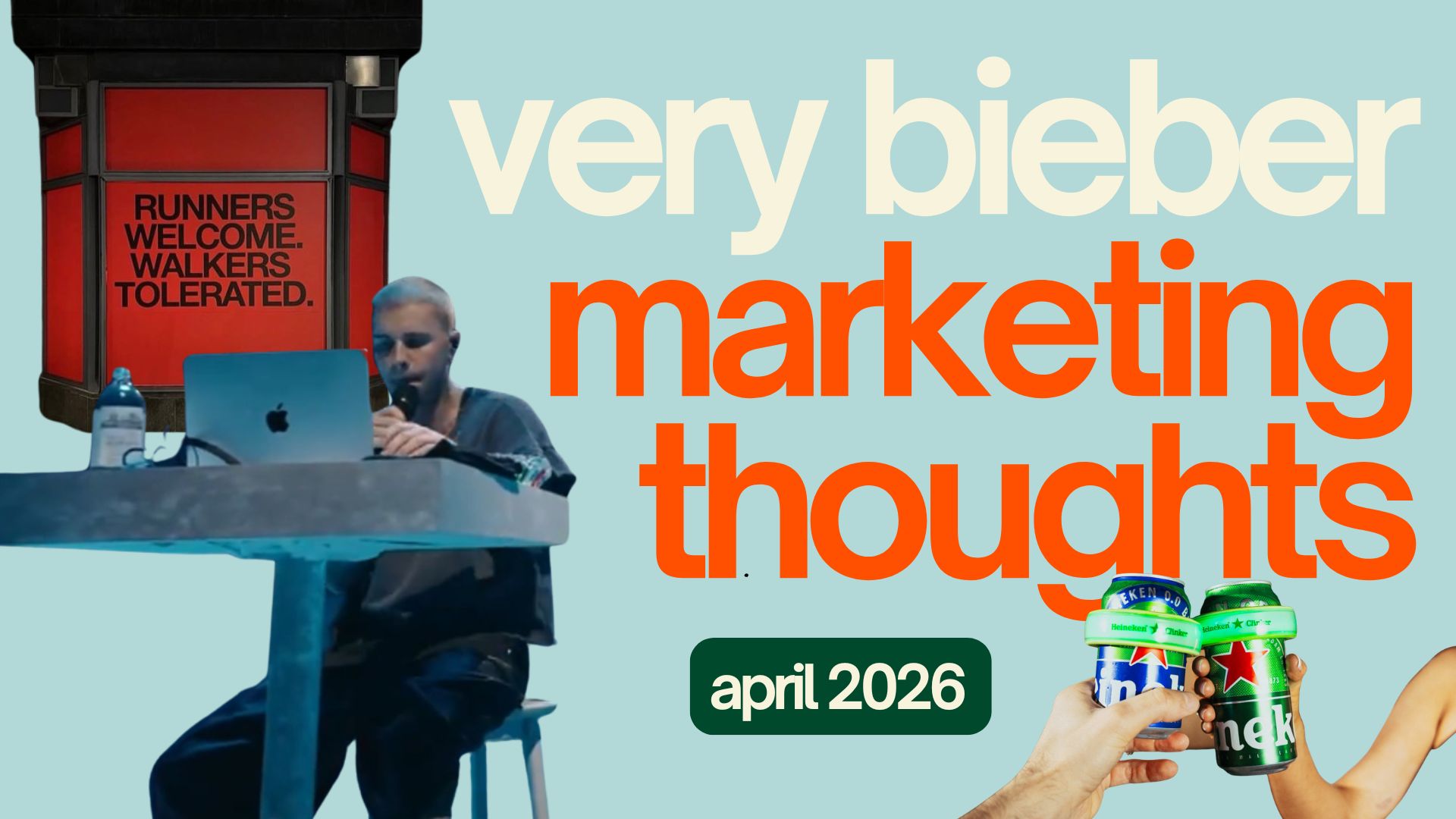
I said I wouldn’t talk about Coachella, but I am going to include one because it’s been sitting in my head and I can’t quite shake it. Heineken has this fans have more friends brand platform at the moment, which I actually really like. As a brand idea, I think it’s super strong. It’s simple, it’s ownable, and it gives them a really clear lens for how they show up at things like music festivals and sporting events. The idea of taking shared fandom and turning it into something more social is a good one, and you can see how it could stretch across a heap of different executions.
And this Coachella activation is one of those executions. They created these little devices that sit on your drink, and when you cheers with someone else who has one, it pulls your music data, shows what you have in common, highlights compatibility, and lets you connect on social. Which, on paper, is v cool. It makes a lot of sense when you tie it back to the brand platform.

But I keep coming back to this question of… who actually used it, and what actually happened after? Because if you were in the Heineken tent that weekend, or you work in marketing, or you read trade publications, you’ve probably seen this. You’ve probably thought “that’s such a smart idea.” It ticks all the boxes. It’s insight-led, it’s tech-enabled, it’s tied to a strong brand platform. TICK TICK TICKKKKK.
But if you weren’t there, and you’re not in the industry… did this exist for you at all?
And even if you were there, did you actually do it? Did you clink your drink with someone, look at your shared Spotify history, follow each other, and then stay in touch after? Or is it one of those moments where you maybe do it once, think it’s funny, follow someone, and then three weeks later you’re scrolling your following list going “who is this person and why do I have them on here?”. It’s how I feel when I see posts from that girl I met drunk in a bathroom 8 years ago in Europe and wonder why I still follow her.
And I think that’s the bit that’s hard with these types of activations. They’re veryyyyyy hard to measure in a meaningful way. Like yes, you can probably say how many people used the device, how many connections were made, how many social follows happened (maybe?). But the actual outcome the brand is trying to create – which is real, lasting connection – is almost impossible to track. They’re never going to come out and say “X% of people became friends and still talk six months later.”
So instead, what we’re left with is something that gets a whole heap of attention within the industry. It gets written about, it gets shared, it probably wins awards, and it reinforces the brand platform in a very visible way. But does it translate into real-world impact beyond that? Unsure. And to be super clear, I don’t think this is a bad idea. I actually think the thinking is strong, and I think as part of a bigger brand platform, it makes sense. But I also think it’s a really good example of the difference between something that looks great in marketing circles and something that genuinely changes behaviour at scale.
And I feel like I have one of these in every edition – the “good in the marketing world but not that great in the real world” thought. So I guess this is my token one this month!
talking to everyone vs talking to your audience
The last thing I wanted to include this month was the situation with Nike at the Boston Marathon, because I found myself going back and forth on it a lot more than I expected.
They had a couple of billboards around Boston that said “runners welcome, walkers tolerated,” which got a fair bit of backlash, and they ended up pulling it. Not long after, Asics leaned into more supportive messaging and got a lot of positive sentiment off the back of that (as well as a few other brands jumping on board too).

And on the surface, it feels like a pretty straightforward marketing through ahead. Asics did a great job of responding to the moment, Nike got it wrong. But the more I thought about it, the less clear it felt.
Because Nike’s ENTIRE brand has always been about pushing yourself. Going further, going harder, just doing it. And if you think about the audience at something like the Boston Marathon, these are people who have trained extensively, who are there to perform at a high level. So when they see a message like that, does it land differently? Does it actually resonate with that mindset of pushing through and not giving up? And if that’s the case, is the message actually wrong, or is it just not designed to appeal to everyone?
I think that’s the bit I keep coming back to. Not every piece of marketing needs to be for everyone. In fact, the more you try to make something universally appealing, the more you risk it becoming a bit… nothing.
And I think both things can be true here. Asics did a really good job of reading the room and responding in a way that people appreciated. But I also don’t think Nike was necessarily wrong in speaking to a very specific audience in a way that aligns with their brand.
I don’t really have an answer for the “right” thing here – but I know when I ran the 12km HBF fun run with zero prep last year (I know, #peakathleticism) – seeing signage encouraging me to keep running rather than saying “hey it’s okay to walk” actually did help me keep running. So maybe, they actually know what their audience wanted to see while running?
V INTERESTING.
Anyway, that’s as much as I’ll make you read of my ramblings this month – it’s a long one!
If you want to talk Coachella, I have more thoughts. If you want to talk Bieberchella, I have even more.
Otherwise, see you next month 👋
