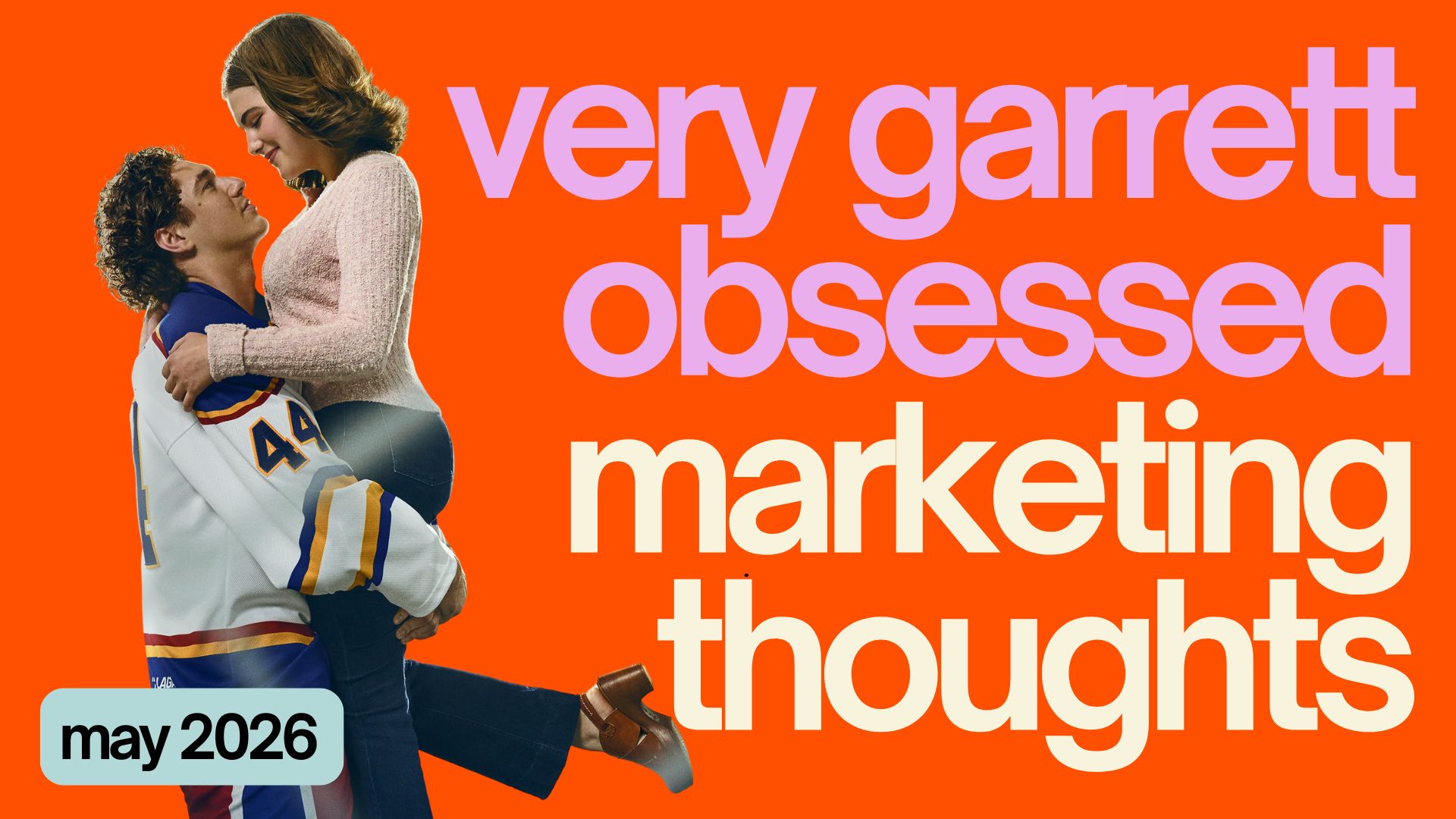
This month’s marketing thoughts are a very mixed bag as always. We’ve ended up with Off Campus, Spotify logo discourse, Phoebe Gates negotiating with creators, Reddit, AI, chicken salt and an existential crisis about the future of marketing all in the same article.
When I looked back over all of these though, they actually all came back to the same thing. People. How people connect, how people buy, how people make decisions, how people negotiate, how people consume content and who they choose to trust. So without really trying, I somehow managed to tie alllll my thoughts this month into one cohesive theme. What a treat! I am very impressed with this accidental
Off Campus, BookTok & why fandom still wants a physical place to exist
Firstly, I do need to acknowledge that me and my friendship group are all in our 30s and yet somehow became completely obsessed with Off Campus. I don’t really know what that says about us, but here we are.
There has been SO much conversation around this show, most of which has absolutely nothing to do with marketing. People are talking about representation, consent, healthy relationships, green flags (of which there are many many many omg I really am obsessed with every character on this show) and all sorts of things. But the thing that caught my attention and made it relevant enough to put into this month’s edition was actually what Amazon Prime did around the launch because I think it’s such a good example of something brands keep forgetting despite the evidence being right in front of them.
As part of the launch, Amazon took over a romance bookstore in Paddington and transformed it into an Off Campus experience. There was merch, craft stations, themed spaces, all sorts of little details that made it feel like more than just a bookstore. And I love seeing stuff like this because every time someone says communities live mainly online now and everything happens digitally, something like this comes along and proves the exact opposite.
I personally think people want both. Digital is epic for helping people find their people. BookTok is a perfect example of that. But once people find a community they genuinely care about, they still want somewhere real for it to exist. They want to meet other fans. They want shared experiences. They want to feel like they’re part of something bigger than a comment section.
The other thing I loved was that it wasn’t an influencer-only event (I feel like I’ve put a lot of shade on influencers in the last couple of articles – please know I have no ill feelings towards them lol). I feel like we’ve reached a point where every cool activation ends up behind a velvet rope. You see all these incredible experiences and then realise they’re only for influencers, creators and media. Which is great if you’re looking for reach as a brand because of course they’re going to post about it to their huge followings, but sometimes it feels completely disconnected from the people who actually care.
What I loved about the Off Campus activation was seeing genuine fans posting about it (and funnily enough – their content going more viral than an influencers would). Not people attending because it was just another event on their calendar to show up at or people who needed content for their feed. Actual fans who were genuinely excited because they loved the books and loved the show and wanted to obsess about it in person as much as they did online. And I really do think there’s a huge difference between those two things.
An influencer might create reach, but a genuine fan creates culture. One gets impressions. The other gets obsession. And I think Amazon have really understood this with all of their show marketing of late – tapping into the ACTUAL fandom rather than the typical influencer event with some logos, a flashy red carpet and nice catering.

The last thing I found super interesting was the timing. The bookstore opened the same day the show launched. There was no waiting around to see if it would be successful. No waiting for viewership numbers. No waiting for social sentiment. Amazon backed themselves from day one (which as a marketer, I’m sure induces just a little bit or a LOT of anxiety). But I think that’s increasingly important because attention moves so quickly now. Even writing this a few weeks later, the Off Campus frenzy has already started to calm down. Not because people don’t love it anymore, but because there’s always another show, another trend and another conversation competing for attention.
I think sometimes brands wait so long for proof that something is successful that they miss the moment entirely. By the time the business case is approved and the event is organised, everyone’s already moved on. So a big kudos to Amazon for backing themselves in and making sure they were ready for the instant obsession and delivered it in the exact moment – a big lesson for us all.
Anyway. If anyone would like to further discuss my unhealthy attachment to fictional hockey players, I am available.
The Spotify logo wasn’t actually the interesting part
I really didn’t want to include this one because I feel like LinkedIn absolutely flogged it to death. Every second person seemed to have an opinion on Spotify changing their logo to a mirrorball for their 20th anniversary and by about the third day I was already over reading about it. People were either acting like it was the worst thing they’d ever seen or saying it was genius because “look, we’re all talking about it”. And in my opinion – I really don’t think Spotify sat around a boardroom table and said, “you know what would be great? If everyone got really annoyed at our logo for a week so we could get some press” Sorry, but that is not what Spotify wanted from that logo change guys.

The part of this entire campaign I personally was interested in wasn’t actually the logo at all. It was the anniversary itself. Around the same time they launched a little retrospective where you could see when you joined Spotify, your listening history, some of your stats and a bunch of social assets you could share. And I found myself thinking… is this all we’ve got? Now before I go any further, I should probably caveat this by saying that Spotify really does some epic marketing and events. They’ve done some chefs kiss campaigns over the years and I think they’re creative AF for the most part. But I did find myself wondering whether Spotify has become a little too reliant on Wrapped-like campaigns as the answer to every big moment.
And maybe that’s unfair because Wrapped was genuinely revolutionary when it launched. It completely changed the way brands thought about using customer data. It wasn’t really about showing people their listening habits. It was about showing people something about themselves. That’s why people shared it. Nobody cared about the actual number of minutes they’d listened to music. They cared about what it said about their identity (hello it’s me, the 0.01% of listeners to Miley Cyrus and Hannah Montana 10 years running). The problem is that Wrapped worked SO well that I feel like every major Spotify moment now somehow circles back to the same formula.
And I think that’s the thing that’s been rattling around in my brain since I opened the app to look at my anniversary wrap: What happens when your best marketing idea becomes your default marketing idea? Because Wrapped still works. People still share it. People still talk about it – sure. But when I compare Spotify’s 20th anniversary to something like Amazon’s approach to Off Campus, one felt like it was creating new experiences and the other felt like it was revisiting an old one. Maybe the data says people absolutely loved it and I’m completely wrong. But for one of the biggest entertainment platforms in the world, I found myself wanting something a little more unexpected.
Am I just over wrapped? Or not that excited about my own data anymore? Am I the only one who really couldn’t care what date I joined Spotify? Unsure.
Sorry, that’s not negotiation
I saw a few people chatting this month about Phoebe Gates trying to work with a creator. If you missed it, a creator had quoted around $4,000 for a package and Phoebe Gates’ startup came back and asked whether she’d do it for $400 instead. Then the internet did what it always does and turned it into a giant debate. Half the comments were about her being Bill Gates’ daughter and how embarrassing it was. The other half were saying she’s running a startup and startups don’t have unlimited budgets and negotiation is always expected. And tbh I really couldn’t care that much about that debate and that’s not the reason it’s landed here. The reason it’s landed here was actually because I feel the entire marketing world has kind of lost the definition of what negotiation is?
I don’t actually think asking someone to do the exact same thing for 90% less money is a negotiation. A negotiation is changing the variables. It’s saying, okay, we can’t afford the full scope, so what can we do instead? Can we reduce the deliverables? Can we change the package? Can we simplify the project? Can we find another way to make this work? That’s a negotiation. Asking for exactly the same thing at a completely different price point is a different conversation. That ain’t negotiation.
And I feel like this really hit a nerve because it’s something I’m starting to see ALL the time. Someone gets a quote and says they’re a startup, or they’re a small business, or they don’t have the budget (which by the way, is completely fair – most businesses don’t have endless cash sitting around. I get that). But budget constraints don’t magically change the amount of work involved for the person delivering. It’s a bit like walking into Woolworths with a trolley full of groceries and saying, “I know this costs $200 but I only have $20.” Woolworths isn’t going to hand it over because you asked nicely. You either buy less stuff or you find another solution.
Some of the best partnerships I’ve ever seen have come from situations where budgets were tight. People get super creative. They reduce scope. They build longer-term relationships. Sometimes people even do things pro bono because they genuinely love the mission or they’re happy to work in exchange for some cash / some product. But all of those examples involve both parties moving. They involve changing something. They involve finding a middle ground. Anyway, maybe this is more of a business thought than a marketing thought, but every time I saw people calling it a negotiation, I found myself thinking that we’ve kind of forgotten what negotiating actually is. Rant over.
I’ve finally lost a client to Claude.
I’ve spent the last two years reading posts about AI replacing marketers. AI is replacing agencies. AI is replacing copywriters. AI is replacing consultants. AI is replacing everyone except the people posting on LinkedIn about AI replacing everyone. And up until now, most of it has felt pretty theoretical. It’s one thing to read a headline. It’s another thing to see it actually happen.
This month was probably the first time it felt real to me. I had a client decide to bring their paid ads in-house and use Claude as part of that process. And for the first time, my reaction wasn’t “that’s ridiculous” or “that’ll never work”. My reaction was actually… yeah fair enough. Now, before anyone interprets that as me saying The Social Lab is doomed, I should probably add some context. This wasn’t a client where we were deeply involved in overall business strategy, positioning, PR, content and all the other pieces of the puzzle. It was a very executional scope. We were largely managing campaigns, implementing activity and helping with execution.
And that’s probably why it made sense. Because I don’t think the question anymore is whether Claude can do a better job than a specialist. I think the question is whether Claude can do a good enough job. And for a startup or small business with limited resources, that’s a very different question. Historically the options were often hire an agency or don’t do it at all but now there’s this third option sitting in the middle where you can use AI to get yourself a decent chunk of the way there. It may not be perfect, but if you just wanted to chuck some ads up and not think too hard? It’ll get you there.
But in alllll the conversations I’ve had, the realisation I’ve come to is that all of this just reinforces something myself and a lot of people I work with have been saying for years. Paid ads were never the whole answer (and they should never be). They’re one piece of a much, much bigger puzzle. And I think the businesses and agencies that have positioned themselves as purely executional are probably the ones that should be paying the closest attention. Because if everyone has access to the same tools, execution becomes less of a differentiator. The things that become valuable are strategy, creativity, positioning, customer understanding and all the messy human bits that sit above the horrible place that is Meta Business Suite.
I don’t know exactly what the future looks like and every time I think about it for too long, my brain starts melting and I question why I work in an industry that moves so quick and needs us to learn so many new things every week. BUT I do think this was the first month where AI stopped feeling like a future conversation and started feeling like a current one to me personally. Not because it’s replacing marketers overnight, but because it’s changing what people are willing to pay marketers for.
I’ve been sleeping on Reddit (sorry Reddit)
I will be the first person to admit that I have massively underestimated Reddit. Not because I thought it was bad. More because it was never really a platform I spent much time on. I knew people used it. I knew there were communities there. I knew there were ads. But it was never somewhere I naturally went when I wanted information.
Lately though, I’ve found myself ending up there constantly. Looking for recommendations. Looking for comparisons, answers and opinions. And what I’ve realised is that I don’t actually think people are searching for information anymore. I think they’re searching for experiences. A few years ago if I wanted to know the best product, I’d Google it. Now I find myself searching for the product name followed by the word Reddit because what I’m actually looking for is someone who’s already done it.
I saw a round table with Quinta Brunson the other day and she was talking about how much she uses Reddit for social listening because it’s one of the few places where people are genuinely honest. And I think that’s exactly what makes it valuable. Everyone knows influencer recommendations can be sponsored. Everyone knows review sites can be manipulated. Everyone knows websites are trying to sell them something. But when you land in a Reddit thread and you’ve got twenty people arguing about the best option, it feels weirdly trustworthy. Not because it’s necessarily more accurate (heck you’ve really got to read Reddit threads with a grain of salt). Just because it feels human.
And I think that’s the bit brands should be paying attention to (and me lol). For years we’ve obsessed over what people are saying on Instagram, TikTok, Facebook and LinkedIn. Meanwhile some of the most honest conversations about products and services have been happening somewhere else entirely. I don’t really have some grand prediction about Reddit becoming the next big thing. I just know that if someone put me on a panel tomorrow and asked me what platform I think is being underestimated, Reddit would probably be my answer. Which is funny because six months ago I definitely wouldn’t have said that.
So I guess this is just an apology to Reddit for not putting them higher on my interests list, and a note to everyone that I really do think it’s worth thinking about how you can get your brand/business/self talked about on there.
PS – If anyone specialises in organic Reddit strategies for brands, reach out. I’d love to chat!
I don’t need a relationship with my chicken salt
The final thought this month is about chicken salt, which feels like the appropriate way to finish.
I came across a new chicken salt brand recently and very nearly bought some. I signed up for the 10% discount code, looked at the prices and then decided that maybe I didn’t actually need a 6 pack of different flavoured chicken salt in my life after all and could just stick with my old faithful chippies chicken salt. End of story. Or so I thought.
Since then, I’ve received nine (yes NINE) emails from them in the space of a month. Nine. NIIIIINE. And look, I love chicken salt. Anyone who knows me knows I love chicken salt. But I don’t think I love chicken salt enough to receive two emails a week about it. And what’s even more wild isn’t just the frequency. It’s the fact that I haven’t actually bought anything. I’ve had recipes, testimonials, referral programs, serving suggestions, loaded fries inspiration and enough content to become a chicken salt influencer despite never purchasing the product.

And that’s the bit that qualified it for a marketing thought this month. At no point did this brand stop and ask why I didn’t buy. They just immediately moved me into what felt like a post-purchase nurture sequence. Meanwhile I haven’t even committed to the chicken salt yet. The entire thing felt completely disconnected from the context of what I’d actually done, which was request a discount code and then not buy.
I think this is something brands get wrong all the time (especially in the email marketing space). They get SO excited that they’ve captured an email address that they stop thinking about customer intent. Because all I’ve really done is show mild interest. That’s it. It doesn’t mean I want a relationship. It doesn’t mean I want twice-weekly updates. It doesn’t mean I want to become part of the chicken salt community. It means I was considering buying chicken salt and then didn’t.
To me, the most important thing about any marketing – especially EDMs – is context matters. The frequency should make sense for the product. The content should make sense for where the customer actually is in the journey. And the communication should reflect the level of intent they’ve shown. Because after a month of being relentlessly pursued by a chicken salt company, I unsubscribed. Which feels like quite an achievement when you think about it. They took someone who was genuinely interested and turned them into someone who actively opted out. That’s not easy to do when you’re selling something as universally loved as chicken salt. And even if I had bought some chicken salt – I still don’t think I need 2 emails a week about it right? That feels just a taddddd excessive???
Chuck in their retargeting ads hitting me up twice a day on Instagram and you’ve somehow put off what should have been your easiest customer. Context matters people.
That’s it for May – hope you enjoyed!
See you next month 👋
